Industrial Coatings
What Is the Best Flooring for Forklift Traffic?
By Legacy Industrial Coatings
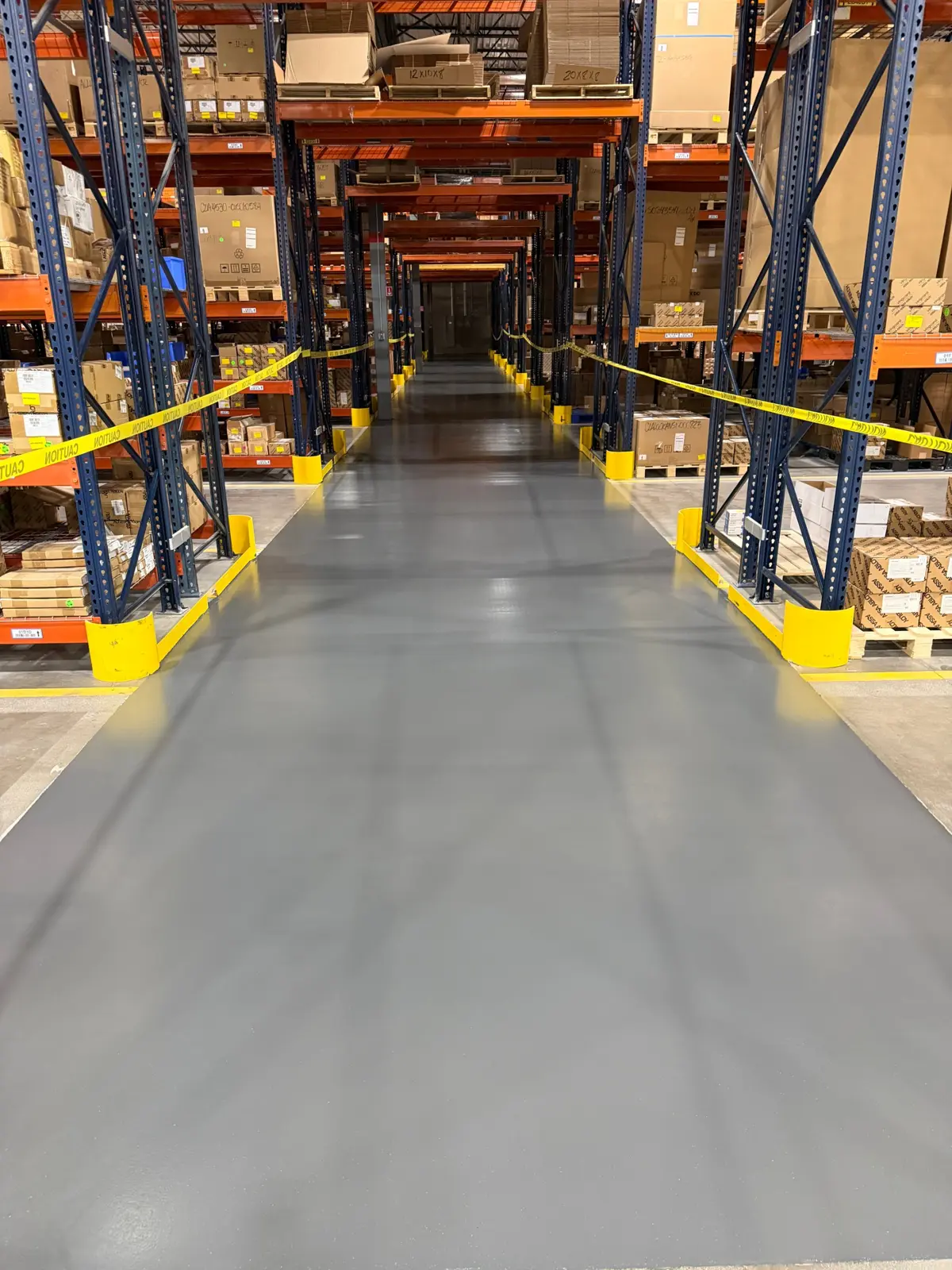
For most warehouses and distribution centers, the best flooring for forklift traffic is an industrial epoxy system finished with a high-traffic urethane topcoat, or polished concrete if the slab is sound and the space stays dry. Where forks, pallets and dropped loads hit the floor hard, a heavier troweled or broadcast epoxy is the better choice, and where heat or hot washdown is involved, urethane cement holds up best.
The right answer depends less on the forklift and more on the slab underneath it, what else the floor has to survive, and how much downtime you can give us. Here is how those conditions change the recommendation.
What Forklifts Actually Do to a Floor
Forklifts wear a floor in three ways. Hard wheels grind the surface in the same lanes every day, so abrasion shows up first in aisles, turns and dock approaches. Loads get dropped, dragged and set down hard, which chips thin coatings and breaks out weak concrete. And wheels slam across every saw-cut joint and crack, which is where most warehouse floors start to fail.
A good forklift floor handles all three. That means the right coating or finish for the traffic, a slab prepared so the coating stays bonded, and joints that are filled and supported.
The Main Options
Epoxy with a high-traffic urethane finish
This is the workhorse for most warehouse and production floors. The industrial epoxy bonds to the ground concrete and gives you a seamless, cleanable surface with color, safety zones and slip-resistant texture built in. A urethane topcoat over the epoxy takes the abrasion from wheels and keeps the floor from scuffing and dulling in traffic lanes. It is a strong fit when you want a bright, marked-out floor that cleans easily.
Heavier troweled or broadcast epoxy
A thin coating is the wrong choice where loads get dropped or dragged, or where steel-wheeled carts and heavy equipment run. In those areas we step up to a heavier epoxy, either broadcast with aggregate for body and grip or troweled as a mortar. These builds absorb impact that would chip a thin film, and they can be used only in the high-abuse zones rather than across the whole building.
Polished concrete
If the slab is in good shape and the space is mostly dry, polished concrete is hard to beat. The concrete itself becomes the wearing surface, so there is no coating to wear through under forklifts. It has little downtime and low maintenance. It is not the right fit for a badly damaged slab, for chemical spills, or where you need a sealed, color-coded surface.
Urethane cement
Food plants, beverage operations and any area with hot water, steam cleaning or temperature swings need something tougher than standard epoxy. Urethane cement moves more like concrete when temperatures change, handles washdown and stands up to forklift traffic in wet, hot rooms.
Joints and Striping Matter as Much as the Coating
Many forklift floors that look like coating failures are really joint failures. Open saw-cut joints let wheels chip the edges, and the damage spreads into the coating on both sides. Filling joints with a semi-rigid filler that supports the edges is one of the most effective things you can do for a forklift floor. Our joint filling and crack repair work is usually part of the same project as the coating.
Markings matter too. Line striping for aisles, pedestrian walkways and staging zones has to hold up to the same traffic as the floor. Striping that is properly prepared and installed lasts; paint rolled onto a dusty slab does not.
On a 40,000 SF distribution center in Plano, we installed epoxy walkways with a high-traffic urethane finish and new line striping in about two weeks. You can see that Plano distribution center project here.
How to Decide
- Sound slab, dry space, mostly forklift traffic: polished concrete, with joints filled.
- You want color, safety zones or a sealed surface: epoxy with a high-traffic urethane finish.
- Dropped loads, dragging or heavy equipment: a heavier broadcast or troweled epoxy in those zones.
- Heat, hot water or washdown: urethane cement.
- Battery charging or chemical spills: a chemical-resistant system like novolac epoxy in that area.
Many buildings in Dallas–Fort Worth and across Texas use two or three of these in one facility. We look at how your equipment actually moves and recommend a floor for each area, not one product for the whole building. You can read more on our warehouse flooring page.
Frequently Asked Questions
Can a regular epoxy coating handle forklifts?
Yes, as long as the build matches the load. A thin coating works for light traffic, but busy forklift lanes need a properly prepared industrial epoxy with a wear-resistant topcoat, and impact zones need a heavier build.
Why is my forklift floor chipping at the joints?
Wheels hit the unsupported edges of open joints every pass. The edges spall, and the coating breaks with them. Filling the joints with a semi-rigid filler supports the edges and stops most of that damage.
Is polished concrete or epoxy better for a warehouse?
Polished concrete is great on a sound slab in dry space and has nothing to wear off. Epoxy is the better pick when you need color, safety markings, chemical resistance or a sealed surface over a slab with damage.
Can you install a forklift floor without shutting down the building?
Usually, yes. We phase the work zone by zone, on nights and weekends, so shipping and production keep moving while each area is coated and cured.
If you are planning a warehouse or production floor, request an estimate or send us your plans. We will walk the site, look at your traffic and slab, and recommend the floor that fits each area of your building.