Epoxy Floor Repair & Recoating
Peeling, bubbling, yellowing or worn-through epoxy usually means something went wrong under the coating. We find out why the floor failed, then recoat it or remove it and start over the right way.
What Causes Epoxy Floors to Peel?
Most epoxy floors peel because the coating never bonded well to the concrete. The usual causes are poor surface prep, moisture coming up through the slab, or a system too thin or the wrong type for the traffic and chemicals it sees.
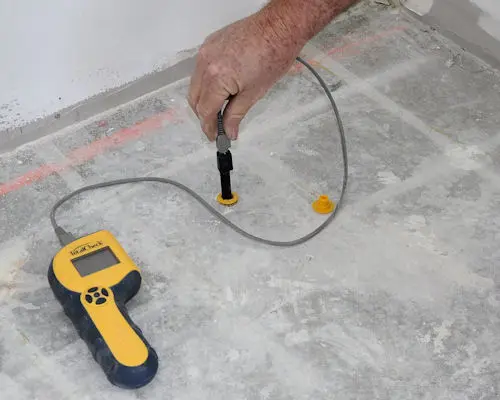
On floors across Dallas–Fort Worth and Texas, we look at how the coating is failing and test the slab for moisture before we quote a fix. If it is still well bonded and just worn, it can often be sanded and recoated. If it is lifting, bubbling or delaminating, it has to come off down to clean concrete first.
Legacy Industrial Coatings installs commercial and industrial epoxy flooring, polished concrete and floor coatings from Plano, Texas, across Dallas–Fort Worth, all of Texas and nationwide. See our commercial and industrial epoxy flooring and polished concrete pages.
Serving Dallas, Fort Worth, Plano, Frisco, McKinney, Richardson, Carrollton, Lewisville and the rest of North Texas, plus Houston, Austin, San Antonio and projects across Texas and nationwide.
Epoxy Problems We Fix
Peeling and delaminating
Coating lifting off the slab is ground off and replaced over properly prepared concrete.
Bubbling and blisters
We test for moisture and outgassing first, so the new floor does not blister the same way.
Yellowing and fading
Discolored epoxy gets a UV-stable topcoat or a recoat so the floor looks clean again.
Hot-tire pickup
Coatings lifted by hot tires are replaced with a build and topcoat made for vehicle traffic.
Worn traffic lanes
Lanes worn to bare concrete are repaired and recoated with a tougher, high-traffic finish.
Root cause, not a patch
Prep, moisture and system choice are fixed so the new floor does not fail like the last one.
Trusted By









And more — pharmaceutical manufacturers, GCs and property managers across DFW and nationwide.
FAQ
Epoxy Floor Repair & Recoating Questions
Can you recoat over an old epoxy floor?
Sometimes. If the old coating is still tightly bonded and the floor is just worn or dull, we sand it, repair damaged spots and apply a new topcoat. If it is peeling, bubbling or lifting anywhere, recoating only traps the problem, so it has to come off first.
Why did my epoxy floor fail?
The most common reasons are poor prep, like coating over smooth or dirty concrete without diamond grinding, moisture or vapor from the slab, and a system that was too thin for forklifts, hot tires or chemicals. We look at the failure pattern to tell which one it was.
How much does epoxy floor repair cost?
It depends on whether the floor can be recoated or must be removed, the square footage, moisture test results, joint and crack repair, and how the work is phased. A site walk shows us how the floor is failing so we can price the right fix, not just a patch.
Can you repair the floor while the building stays open?
Yes. We phase the work zone by zone and can schedule nights and weekends so your busiest areas stay in use. Low-odor options are available for occupied buildings, and we confirm when each zone can take traffic again before we start.
Can you fix just the damaged spots?
Small, isolated damage can often be patched, but patches on epoxy usually show. If the failure is spread across the floor or the cause is moisture or bad prep, spot repairs will keep failing. We will tell you honestly which approach makes sense for your floor.
Tell us what's wrong with your floor
Send a few photos and the square footage. We'll walk the site within 1–3 business days and tell you whether it needs a repair, a recoat or a new floor.
Request Information
Tell us about your project and we'll follow up within one business day.
Prefer to talk now? Call (214) 305-6516 or